In crisis situations, the hardest step is often not solving the problem — it’s asking for help.
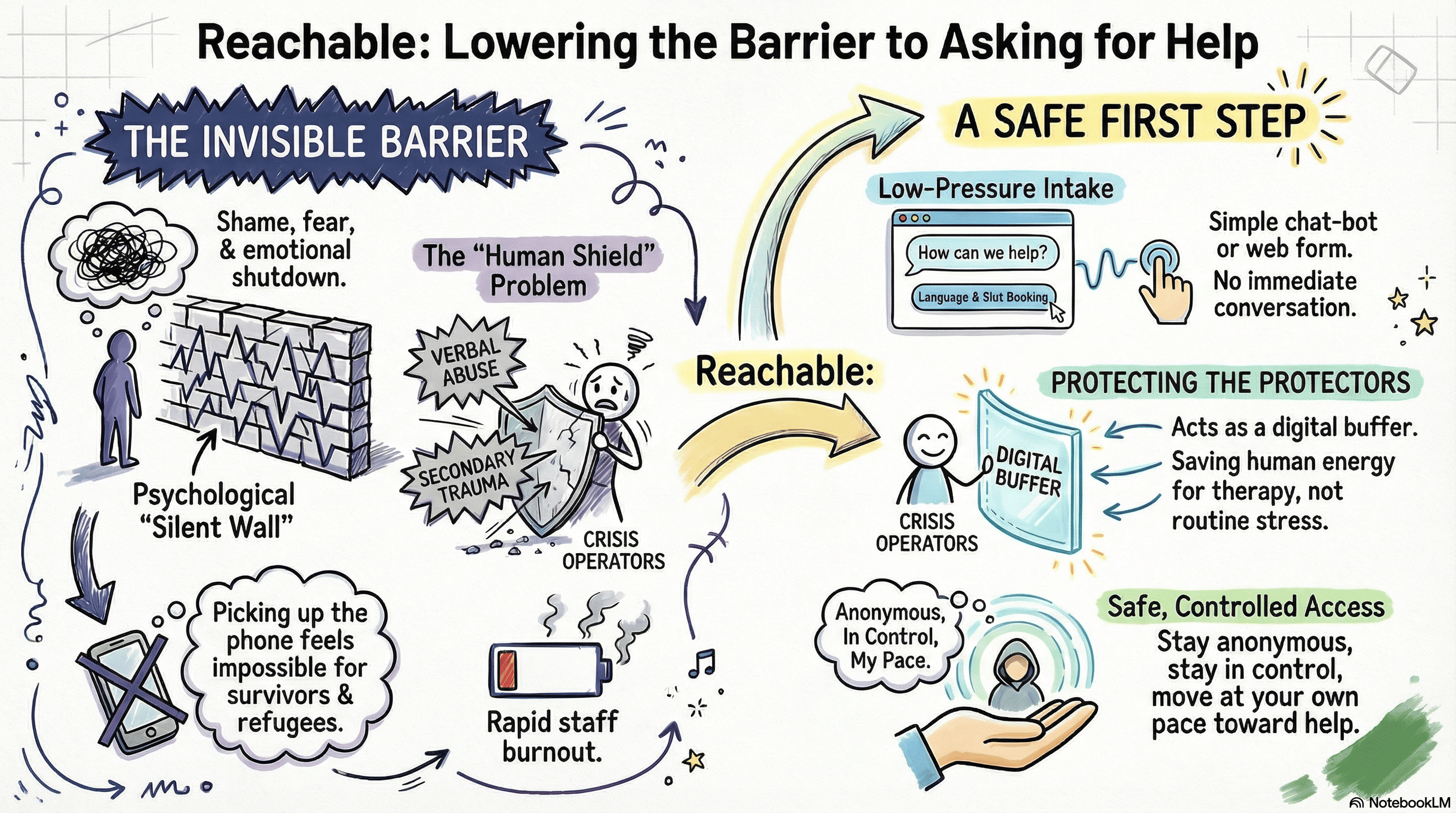
For many people — especially refugees, survivors of violence, or those living with PTSD — even speaking to a human operator can feel overwhelming. Shame, fear, language barriers, or emotional shutdown can create a silent wall.
This is where support systems often fail.
The Problem We Saw
A European non-profit organization working with vulnerable populations shared a recurring issue:
Many people who need help never reach out — not because they don’t want support, but because they can’t cross the first psychological barrier.
This includes:
- survivors of domestic violence
- displaced people and refugees
- teenagers and children
- people in acute emotional distress
Even picking up the phone can feel impossible.
What We Built
We created a lightweight intake and booking system that removes this barrier.
Instead of calling:
- a person starts with a simple chat (Telegram bot or web form)
- selects language and basic context
- answers a few non-invasive questions
- immediately receives available time slots with a specialist
No pressure. No conversation required.
Why This Matters
This is not about automation replacing people.
It’s about creating a safe first step.
A moment where someone can:
- stay anonymous
- stay in control
- move at their own pace
And still reach real human support.
Behind the System
The platform includes:
- intelligent triage (urgent vs normal cases)
- multi-specialist calendar matching
- automatic session booking
- minimal reporting for psychologists
- anonymized data tracking for NGO reporting
All designed to reduce friction — for both clients and providers.
Zero-Effort Reporting & Real-Time Analytics
One of the biggest administrative burdens for NGOs is tracking actual work performed. Reachable automates this entirely.
Immediately after a session ends, the bot sends a quick confirmation form to the specialist. In seconds, the psychologist confirms the visit, its duration, and type of work.
What this means for the organization:
- Audit-Ready Statistics: Instant, clear data for donors and regulatory bodies.
- Operational Control: Full visibility into actual hours worked by specialists for payroll and resource management.
- Real-Time Monitoring: Track trends as they happen. See a sudden spike in crisis cases or a drop in youth engagement today, not next month.
- Deep Categorization: Filter impact by category (teenagers, crisis, etc.) for any period with 1-day granularity.
Privacy by Design: All data is stored in an encrypted database compliant with EU GDPR standards. For external reporting, we use unique hashes instead of client names or aliases. The Google Sheets export remains fully anonymized while providing 100% transparency on the work performed.
Protecting the Protectors: The Operator’s Burden
There is another silent crisis: the mental health of the people answering the phones. Operators on crisis lines are often the targets of displaced aggression, verbal abuse, or simply the overwhelming weight of hearing trauma for 8 hours a day.
Secondary traumatization is real. By the time a specialist gets to help a client, the "gatekeeper" (the operator) might already be burnt out.
Reachable acts as a digital buffer. It filters the initial noise, handles the routine intake, and ensures that when a human specialist steps in, they are stepping into a structured, prepared session — not an emotional battlefield.
Current Status
The system is currently in closed alpha testing with a European non-profit organization.
Why We’re Doing This
This project is being developed as a pro bono contribution.
It started with a simple realization:
Sometimes people don’t ask for help — not because they don’t need it,
but because the system is too hard to approach.
We’re trying to change that.
What’s Next
If you work in mental health, crisis response, or humanitarian support and see similar challenges — we’d love to connect.
This is just the beginning.

Comments (0)
Be the first to leave a comment.
Leave a Comment