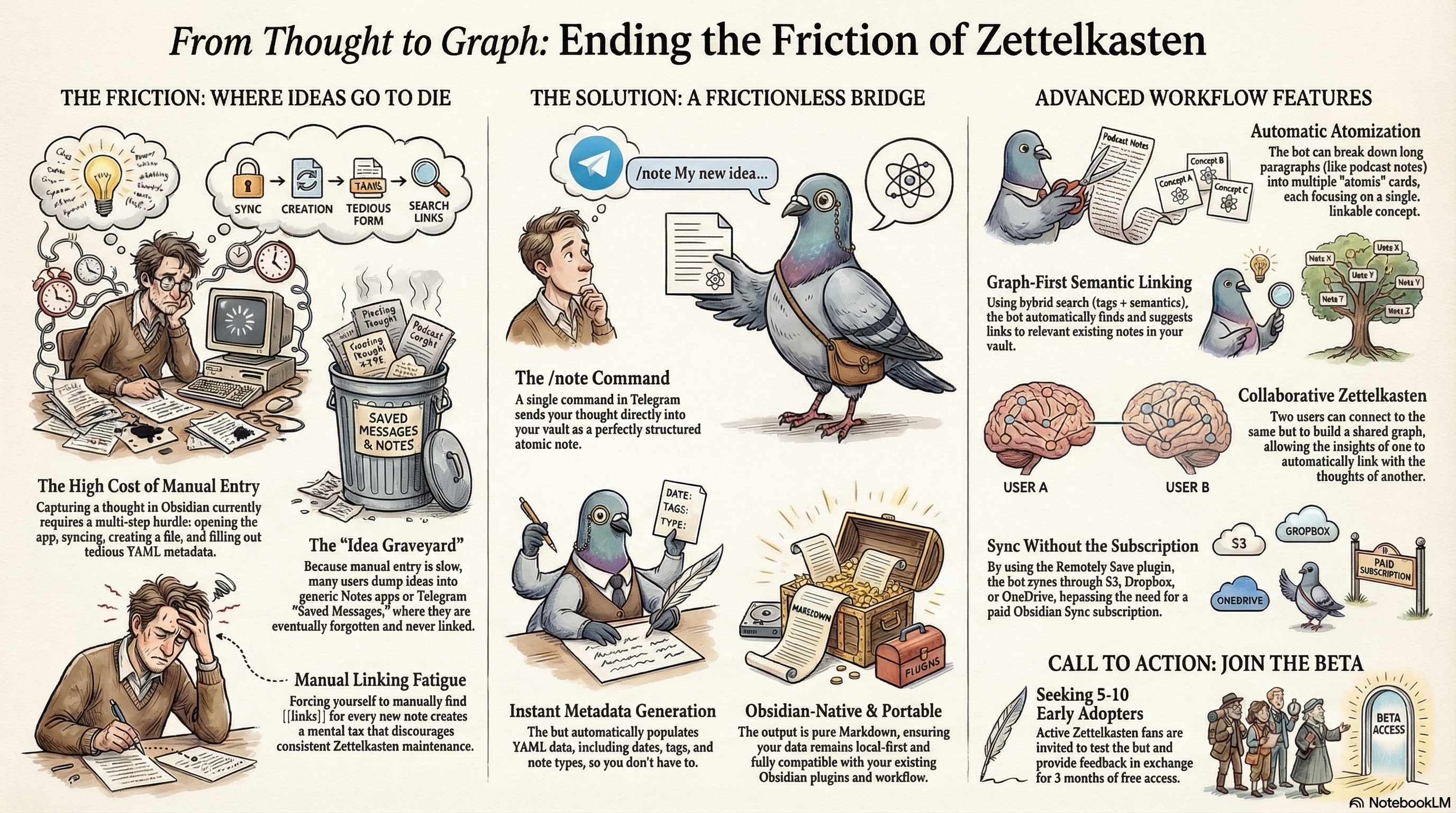
If you use Obsidian and the Zettelkasten method, you probably know the main pain point: friction at the point of capture. Ideas show up at the worst possible moment: on the subway, on a walk, in the middle of a chat. To turn a raw thought into a proper note in your system, you have to go through a whole ritual: open Obsidian, create a new file, fill in the YAML frontmatter, come up with a title, then think hard about how to link it and manually add all the [[links]].
By the time you’ve done that, the idea has already cooled down or disappeared. So most of the time, we choose the path of least resistance: we throw the idea into the phone’s default Notes app or Telegram “Saved Messages”. That’s how it ends up in digital purgatory — a huge graveyard of ideas tagged “sort later” that we never actually return to.
Recently I ran into a tool that completely changed this dynamic: a simple Telegram bot. Working with it gave me several clear insights into how a knowledge management system is supposed to work.
Six key insights
Here’s what I realised after removing the main bottleneck on the way to a more effective Zettelkasten.
Insight 1: The entry point to your system must live where you already are
“Frictionless capture” is not about a new shiny app. The best inbox is the tool you already use dozens of times a day. For many of us, that’s Telegram. A bot turns a familiar messenger into a direct portal into your knowledge graph.
This is a simple but important shift. You don’t have to “go to your system” to record a thought. The system comes to you, in chat. The idea is captured while it’s still “hot”, without losing energy or context. The process turns from a small chore into a natural continuation of your thinking.
Insight 2: The real power of Zettelkasten is in automatic linking
The bot doesn’t just store notes. Its main feature is a graph‑first approach to linking. It actively builds your knowledge graph by analysing each new note and inserting [[Zettelkasten-style links]] to existing, relevant ideas in your vault. It looks for connections not by folders, but by semantic context and tags.
Manual link‑hunting is the most time‑consuming and most often skipped part of Zettelkasten. Automating this step lets your graph grow organically. Every new thought is not only saved but immediately placed inside the network and connected to existing ideas.
We’re good at writing things down. We’re much worse at not losing them — and at connecting them.
Insight 3: A long thought usually consists of several small ones
One of the core principles of Zettelkasten is atomicity. Each note (“card”) should contain one complete idea. This makes it flexible and easy to connect with many other ideas. In practice, though, we often write in long paragraphs and mix several concepts in one place.
The bot solves this by automatic atomisation. If you send it a long text — for example, a key passage from a book or notes from a podcast — it can intelligently split it into several separate but linked atomic notes.
This is more than a technical feature. It’s a built‑in coach that teaches you to break complex thoughts into simple units and design notes for connection, not just for storage.
Insight 4: Collaboration is not file sharing, it’s a shared brain
The most unexpected insight for me was about collaboration. The bot can connect two users to the same Obsidian vault, creating a shared Zettelkasten. In practice, this turned out to be more than just “sharing notes”.
When you build a shared knowledge graph, one person’s ideas automatically find touchpoints with the other person’s notes. The system highlights intersections you might not have seen. For co‑authors, researchers or business partners, it becomes a way to build a real shared “brain”, not just exchange markdown files.
Insight 5: Real data ownership means freedom from walled gardens
The bot is “Obsidian‑native”. In other words, the output is standard, portable Markdown files in your local vault. No proprietary formats, no lock‑in, no move to a new closed ecosystem. You keep your stack and simply add a better input and linking layer.
It also removes the need to pay for Obsidian Sync. The bot integrates with the free Remotely Save plugin, so you can sync your vault through any cloud you like (pCloud, Dropbox, OneDrive, S3, etc.).
This supports a simple principle of modern knowledge management: local‑first, fully portable. Your notes live on your machine, under your control, not inside a paid, closed service.
Insight 6: Turning chat from an archive into a living thinking system
The main effect of this approach is a shift in how you treat chat. Telegram stops being just a noisy feed or a dead archive of saved messages. It becomes a dynamic entry point into a living, growing thinking system.
Each message you send to the bot doesn’t disappear into history. It becomes an active node in your knowledge graph that can be rediscovered and re‑combined months or years later.
From archiving to connecting
For me, this experience showed that the future of knowledge management is not about making capture 5% easier. It’s about tools that take on the hard part: finding and creating connections. Systems that help you not only collect facts but build understanding.
In the end, this changes how you think. What if your next insight doesn’t need to be “found” — because your system will surface its connection to something you thought about a year ago?

Comments (2)
Great idea.
Great idea.
Leave a Comment